
Companion story
Jean-Michel Jarre, fellow traveler. Part 1: Paris, 1969–1982
Jean-Michel Jarre told the magazine Mojo that he and Tangerine Dream had “started at more or less the same time”, without knowing they were making the same music. It is a fair description. In the years when the young Berliners were finding their way into electronic sound in cellar clubs, a young Parisian was finding his in a state radio laboratory, and by the late 1970s their records circulated side by side. The musicians themselves kept carefully apart, and Jarre and Tangerine Dream would not meet until 2014. This is the story of the Paris side, from the laboratory to a stadium in China.
A key to the studio
Jarre was born in Lyon in 1948, the son of the film composer Maurice Jarre. By 1968 he had nearly given up conventional instruments for tape loops, backward tape and changes of speed, and the drummer in his band told him about a research service at French state radio where people made music in a different way. In 1969 he joined Pierre Schaeffer’s Groupe de Recherches Musicales in Paris. It took four students a year from some two hundred applicants. Jarre remembered the entrance test as four hours alone in a booth with a tape recorder, scissors and tape.
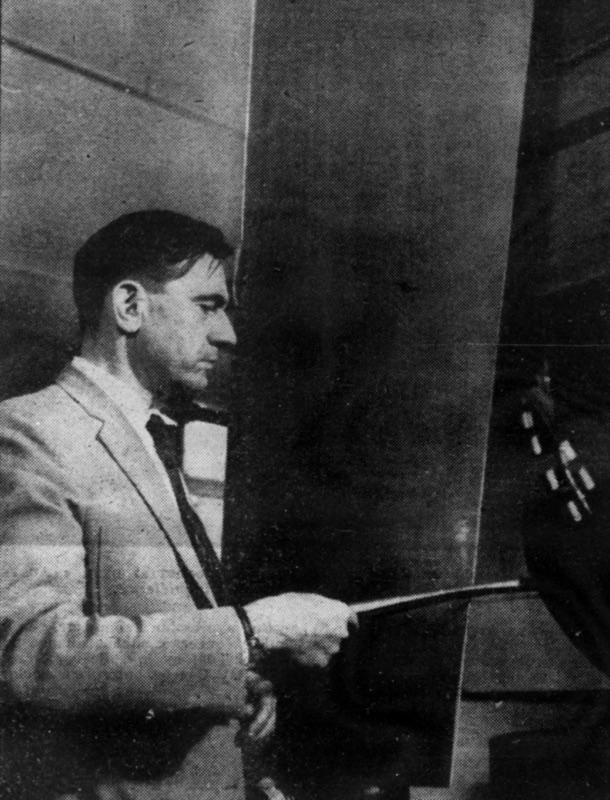
The group’s equipment came from the radio studio: tape machines, filters and a big bank of oscillators, ring modulators and envelopes that nobody yet called a synthesizer. The students were not allowed to touch it, so they had a copy of a studio key made and recorded at night. From Schaeffer, Jarre took the idea that music is sound, not notes, harmonies and chords.
He stayed three years and then left, because he felt more a musician than a researcher. He remembered the composer Iannis Xenakis telling the students that anything that came from emotion was suspect in art, and that sat badly with him; emotion, for him, was where creation began. Outside the laboratory, groups such as Pink Floyd and Soft Machine were experimenting by trial and error and, to his ear, getting more interesting results. Schaeffer himself told him not to waste his time, and to go and meet the public.
In Berlin in those same years, the young musicians around Froese and Klaus Schulze were finding their way into electronic sound through the Zodiak and Thomas Kessler’s Beat Studio. Their road ran through rock clubs and cellars. Jarre’s ran through French pop.
The songwriter
He went to work. In October 1971, for the reopening of the Paris Opéra, he wrote electronic music for a ballet, AOR; some of the orchestra’s musicians feared the technology would take their jobs, and a few unplugged his sound system during the run. He wrote jingles, among them one for Pepsi-Cola that made the contemporary-music purists howl, as well as film music and songs. With the singer Christophe he made two concept albums, Les Paradis perdus (1973) and Les Mots bleus (1974), writing most of the words for the first, and both were hits. He took the Swiss singer Patrick Juvet to Los Angeles to record with leading American players, and their Paris by Night (1977) was a major hit.
He had bought his first synthesizer, an EMS VCS 3, in London, because nothing like it could be had in France, and paid for it by selling his guitar and amplifier. He called it a poor European version of the Moog, drier and harsher than the American machine, “a kind of punk synthesiser”. It was the same small British synthesizer the Berliners were using; Tangerine Dream had borrowed one for Alpha Centauri in 1971. Royalties from his songs paid for an ARP 2600, and his production work for a studio in the kitchen of his Paris apartment. In 1974 he heard a lecture by the instrument designer Michel Geiss, then phoned him and invited him over. Geiss, a technician at the Barclay studios, became his technical partner for years.
That same year Jarre first heard Kraftwerk’s Autobahn, while he was already preparing Oxygène. In his memory electronic music hardly existed yet. He felt marginal, and he had no contact with the German groups.
The kitchen
Jarre recorded Oxygène between August and November 1976. He described the composing as six weeks’ work with very limited tools. Almost every sound came from the VCS 3. The pads came from an Eminent string organ run through a guitar pedal. The Mellotron had been damaged in an earlier pop session, and he wrote Part II around the few keys that still worked. The rhythm box, a Mini-Pops, could play only one preset rhythm at a time until he taped two of its buttons down. The sense of space came from a Revox tape machine used as a delay, with the dry sound on the left and the delayed copy on the right; about half of what you hear on the album, he reckoned, is that delay. Geiss came over in the evenings, after his day at Barclay, to record him.
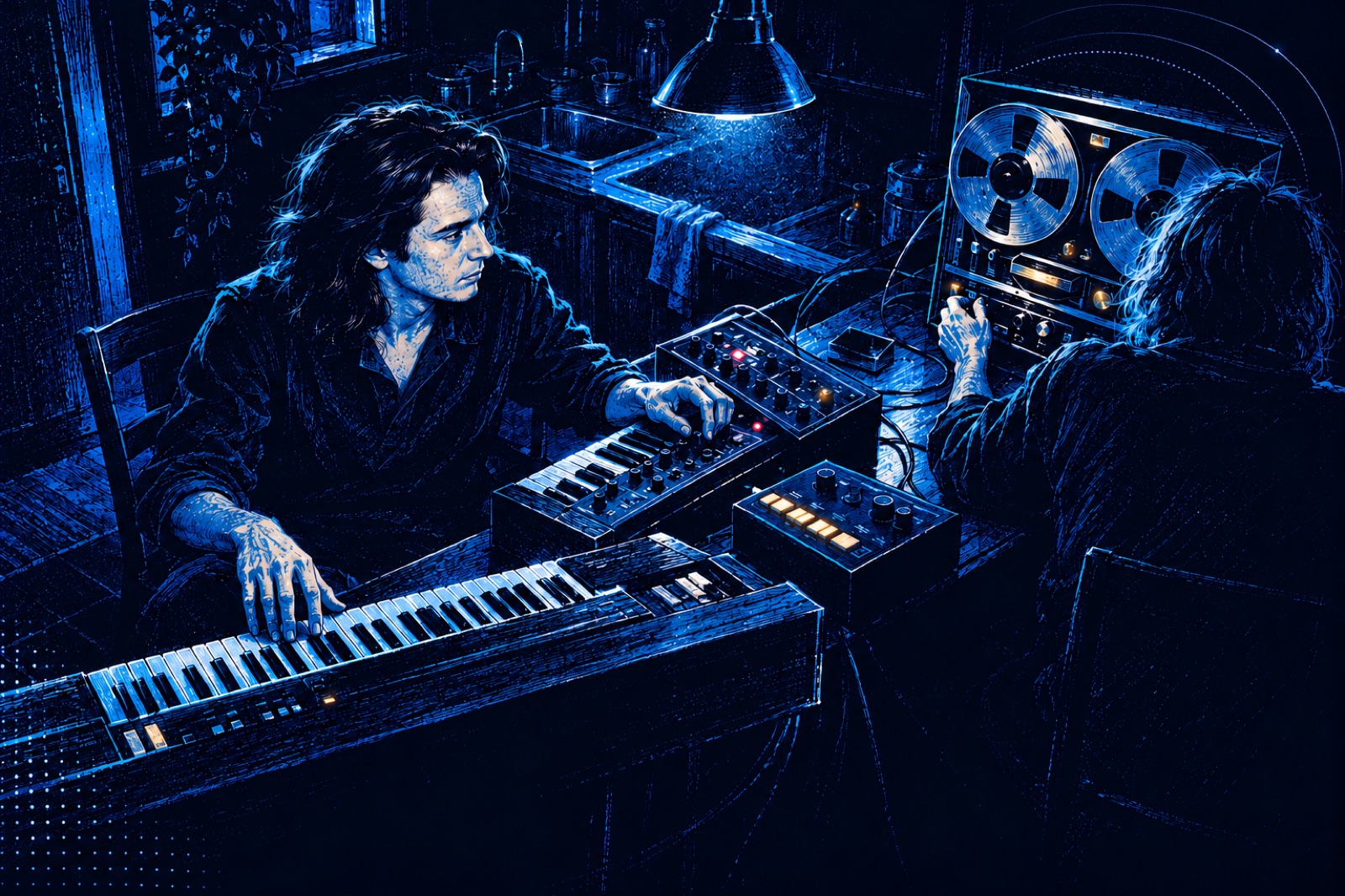
There was no sequencer. Jarre played every repeating figure by hand, and a wrong note meant playing the section again. He traced the habit to a Terry Riley recording session he had assisted at as a student, where Riley played his repeating organ figures by hand. In 2008 he said he had been obsessed with nothing repeating in exactly the same way, which he thought the opposite of the attitude of Kraftwerk and Tangerine Dream, whose music he heard as more robotic.
Press ▶ in the player to start.
This video can’t be played here. It may be blocked where you are, or no longer available. Try it on YouTube ↗
Listen
Jean-Michel Jarre, “Oxygène (Part II)” (1976)
Listen for: the bouncing figure over a restless bass line, and the Mellotron choir from a machine with only a few working keys.
Full piece on YouTube ↗Playing loads this video from YouTube (Google); Google’s privacy policy applies.
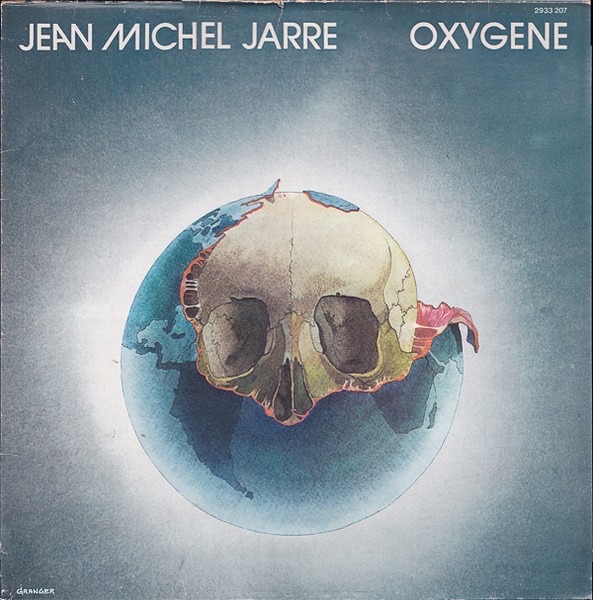
He thought of the record as one piece in six movements, like a book whose chapters are not named, and compared it to abstract painting. He described the mood as sunny melodies in dark surroundings, like the cover, a watercolor by Michel Granger of the Earth with its crust peeled back to show a skull. The best-known part had the lightest origin. In 1972 Jarre had released his own version of Gershon Kingsley’s “Popcorn”, then a hit for Hot Butter, under pseudonyms and without success; slowed down and given more space, its refrain became “Oxygène (Part IV)”.
Nearly every record company turned Oxygène down. Francis Dreyfus’s small label, Disques Motors, released it in December 1976 and, with radio against it, sold it through hi-fi shops. Then the stations gave in, and it went everywhere. In 1977 the Académie Charles Cros in Paris gave it the Grand Prix du Disque, the academy that had given its prize to Schulze’s Timewind.
Horizontal and vertical
Jarre was ready to explain the record from the start. The word “electronic”, he told French television in 1977, caused great confusion, because for most people it meant the vacuum cleaner and the washing machine. It was the energy of the instruments that was electronic, not the music; violins and pianos are mechanical instruments too.
Success brought the comparison, and Jarre made it himself. In 1977 he said the German groups treated the machine as an end in itself, which he called a German habit of mind. They built their pieces horizontally, he said: Schulze could arrange sounds in a very interesting way but held one mood for twenty or forty minutes, while he wanted a piece to pass through romantic, tragic and funny moments. Later he called Oxygène vertical, more melodic and less repetitive than the German instrumental music of its time. He also repeated a rumor that the members of Tangerine Dream left the stage and let their machines play, which seemed to him music for a public of machines. Froese denied it.
The British press took the Germans’ side. The NME called Oxygène “infuriatingly derivative” of the German groups that had mapped the territory years before, and Melody Maker found its successor, Équinoxe, “slushily, pseudo-galactically crass and vapid”. The Berliners themselves were not generous. Schulze’s official site later described a Frenchman out of nowhere, from advertising, doing what Schulze had done with “a bit more calculated pop approach”, and in 1983 Schulze said he was against trying to make an electronic hit as Jarre had, and could never do it. Others heard the difference more kindly. The Dutch broadcaster Ad Visser, who played Oxygène on his radio program in 1977, noted that almost all synthesizer pop was made by Germans, and that Jarre’s music was generally more playful and warmer.
Listeners didn’t sort the music so strictly. From the 1970s the label “space music” was attached to Jarre, Vangelis, Schulze and Tangerine Dream alike, and for many buyers Jarre was the way in. In a West German radio poll of 1994, listeners ranked him fourth among all artists and put Équinoxe sixth among albums.
Something for the eye
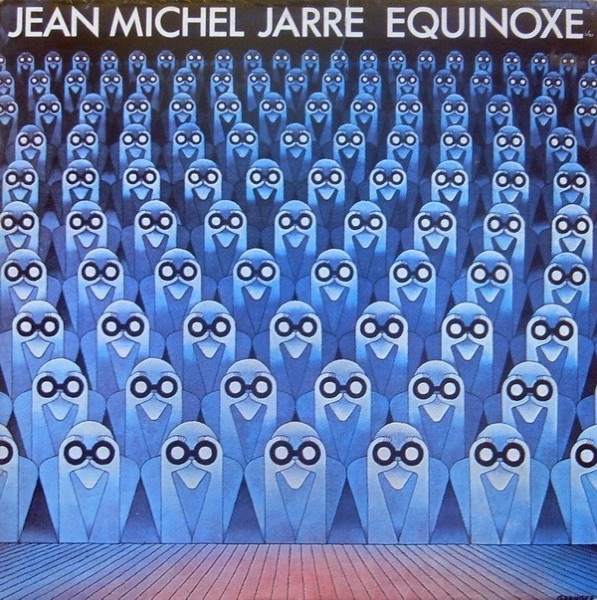
Équinoxe took most of 1978, made in the same apartment, now on a sixteen-track recorder. Oxygène had been made without a concept. The new record was meant as a day in a life, from waking to sleep, in eight parts, with rain, water and storm sounds designed by Geiss running through it. For it Geiss built Jarre the instrument he had asked for, a sequencer laid out as a matrix of pins on a board. Each pin set a note and an octave, and a note or a rhythm could be changed while the sequence ran. Jarre defended it on physical grounds: a sequence changed with the hands in real time, he argued, beat one programmed from a keyboard or a screen, where the mind was engaged more than the body. Two layers of sequence usually sat left and right, and a strong single echo carried notes from one chord into the next.
The result was harder and more rhythmic than Oxygène, and many fans heard it as a second part of the first album. The label launched it with a laser show and fireworks outside the Palais des Festivals in Cannes, with the album played at high volume over the loudspeakers; Francis Dreyfus called it a test run for the real thing in Paris.
Press ▶ in the player to start.
This video can’t be played here. It may be blocked where you are, or no longer available. Try it on YouTube ↗
Listen
Jean-Michel Jarre, “Équinoxe (Part 4)” (1978)
Listen for: the pulsing lines of Geiss’s matrix sequencer under a string-machine line and a brassy chorus melody.
Full piece on YouTube ↗Playing loads this video from YouTube (Google); Google’s privacy policy applies.
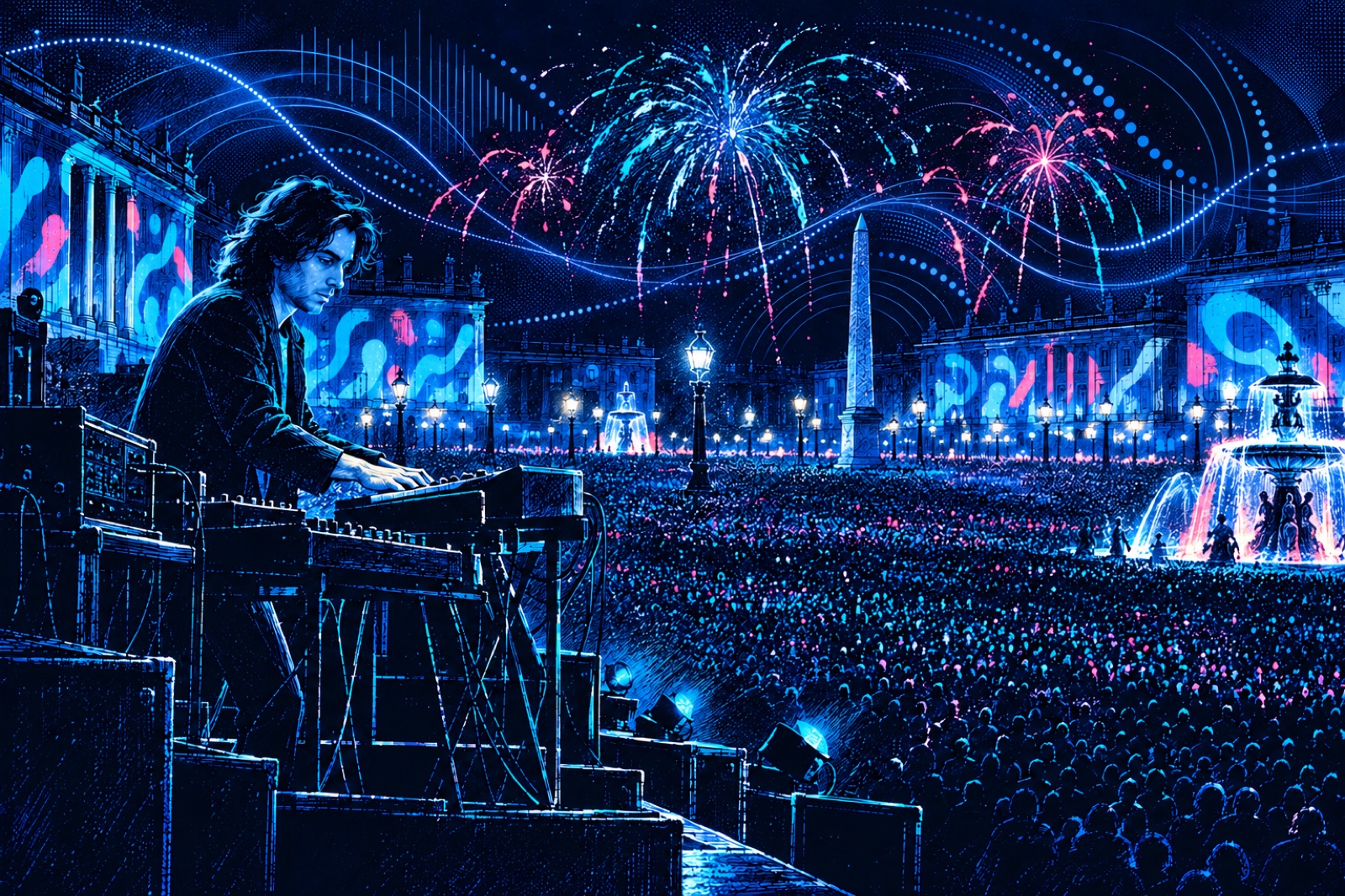
Then he wanted to leave the studio. The concerts of Schulze and Tangerine Dream hadn’t satisfied him, he explained, because they gave the eye nothing to follow, and if the point was only to hear the record, he might as well stay at home. A man behind a bank of knobs, he admitted, is hardly interesting to watch. He looked for visual equivalents to what synthesizers did with sound, and he found that electronic music suited wide open spaces better than halls. On 14 July 1979 he played alone, with backing tapes, on the Place de la Concorde in Paris, among about thirty synthesizers. Slides were thrown on the façades around the square, the streetlamps and fountains were lit in the national colors, and the night ended with fireworks. More than a million people came. The show went out on Eurovision to twenty-three countries, and it took him, he said, a year to recover. The open-air spectacle became his form.
Tangerine Dream had gone the other way at first, playing in near darkness and in cathedrals, though by 1977 it too was touring America with lasers.
Magnetic fields
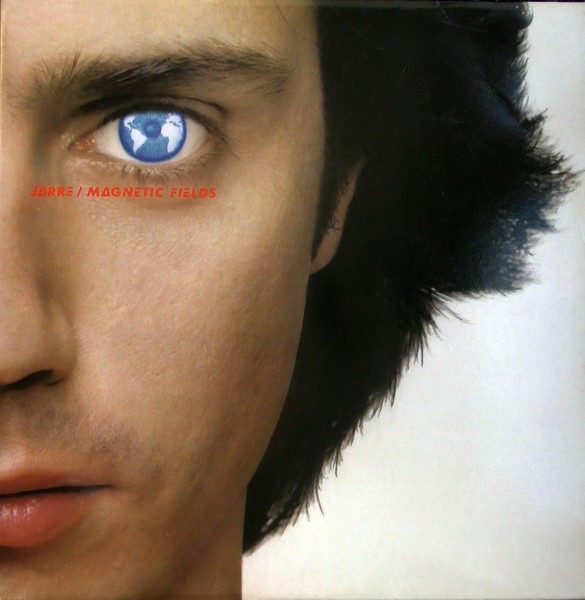
His third album took him back to the laboratory by another door. Jarre and Peter Gabriel were among the first owners anywhere of a Fairlight, a computer instrument that could record sounds and play them back. To Jarre it was the realization of what he had done at the Groupe de Recherches Musicales with tape and scissors: in an hour, he said, it did what had taken three days. On Les Chants magnétiques (Magnetic Fields, 1981) it let him bring musique concrète ideas such as splashing water and the hydraulic doors of trains into his music. The sound of the train was itself a looped sample of a printing press. After the air of Oxygène and the water of Équinoxe, he called the new record more terrestrial, in its rhythms, its sounds and the way it was made; the French title is a pun, since chants, songs, and champs, fields, sound alike.
Its first side is a single piece of about eighteen minutes, a drive of arpeggios and clattering percussion that has been heard as proto-techno, with a slow middle section thick with samples. AllMusic heard the album as the third in a row to bring Tangerine Dream’s atmospheric sequencer trance to a mainstream pop audience.
Press ▶ in the player to start.
This video can’t be played here. It may be blocked where you are, or no longer available. Try it on YouTube ↗
Listen
Jean-Michel Jarre, “Les Chants magnétiques (Part 1)” (1981)
Listen for: the arpeggios and clattering percussion, and the sampled sounds that crowd the slow middle section.
Full piece on YouTube ↗Playing loads this video from YouTube (Google); Google’s privacy policy applies.
China
The two scenes crossed into the East within two years of each other. In January 1980 Tangerine Dream played the Palast der Republik in East Berlin, the first West German rock group to play in the GDR. In October 1981 Jarre gave five concerts in Beijing and Shanghai, the first by a Western pop musician in China. The Rolling Stones and Pink Floyd had tried and failed; Jarre thought the Chinese chose him because his music was all electronic, the music of tomorrow, and not tied to a Western tradition they thought decadent.
He spent two years preparing the trip and went to China three times to talk with officials and musicians, without a manager or a record company. On his first visit he left a synthesizer behind, and the Beijing conservatory formed a working group to compose on it; by the time he returned, the Chinese had built a synthesizer of their own.
At the Concorde he had played alone with backing tapes. In China he played everything live with three other musicians, and in Beijing a traditional orchestra of thirty-four Chinese players joined them. For months he and the orchestra had swapped cassettes, scores going one way and recorded parts the other, but the two groups didn’t play together until the first concert. The novelty of the stage was a laser harp, its beams rising some twenty meters, which Jarre played by cutting them with his hands, each beam a note of a pentatonic scale.
The first night nearly failed for lack of power. Two hours before the start there was not enough current, and a district of Beijing and several factories were cut off so that the sound, lights and lasers could run. The audience, mostly government officials, sat stiffly. The later concerts went better, especially after Jarre walked into the hall with a small synthesizer; the crowds clapped along and asked for autographs afterward, which was not done in China. Seats cost between twenty-five and sixty cents, and some people cycled forty kilometers to come. About 150,000 people attended, television reached perhaps fifty million, and Jarre took no fee.
The double album The Concerts in China (1982) is the live Jarre record to hear. About half of it is new music, and with a real drummer the band gives the older pieces a harder edge.
Press ▶ in the player to start.
This video can’t be played here. It may be blocked where you are, or no longer available. Try it on YouTube ↗
Listen
Jean-Michel Jarre, “Night in Shanghai”, from The Concerts in China (1982)
Listen for: a sequencer piece that stays on one chord, with an improvised flute, a sampled drone and a xylophone-like sequence.
Full piece on YouTube ↗Playing loads this video from YouTube (Google); Google’s privacy policy applies.
Jarre called the trip a dream of ten years. In the years that followed, the paths from Paris and Berlin ran further apart: Tangerine Dream into film scores and digital machines, Jarre into ever larger spectacles, from Houston in 1986 to the Docklands in London in 1988. They would meet more than thirty years later, in a studio near Vienna.
Back to the main storySection 5, “A sound with a name”, after Oxygène ←