
Companion story
Timewind and Moondawn
In the space of a year, between the summer of 1975 and the spring of 1976, Klaus Schulze made the two records that defined him. The first was played alone, live onto tape, in the bedroom of a Berlin flat. The second was made in a little studio in a former Frankfurt cinema, on a machine he had driven across Germany to collect, with a drummer who had first played along with him on a plastic bucket. Between them, Timewind and Moondawn fixed the style Schulze became famous for, and one writer dates the codifying of the Berlin School style itself to the second of them.
Timewind
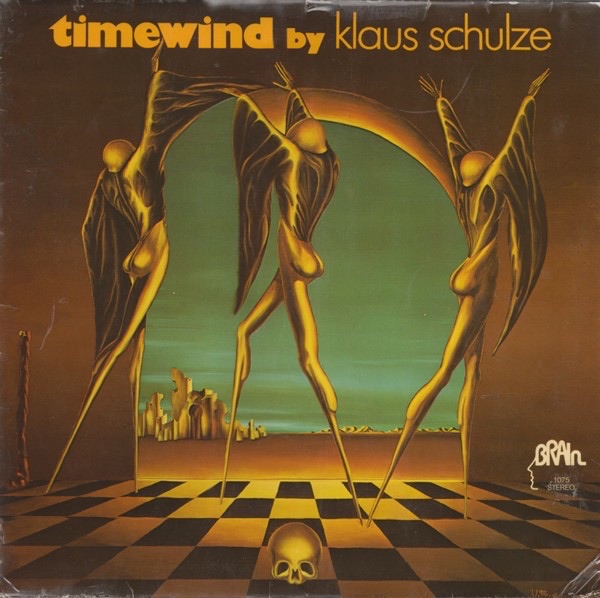
At the start of 1975 Schulze was a solo artist on two labels, Brain in West Germany and Virgin everywhere else, and it was not the arrangement he had wanted. The year before, he had formed a duo with Michael Hoenig, just out of Agitation Free, under the name Timewind. They had negotiated with Virgin and played a few concerts, until Richard Branson told Schulze he could have a solo career or the duo, not both. The duo ended. Schulze liked the name so much that he kept it for his album.
His audience was in France. Der Spiegel noted in May 1975 that Can played to the British, Kraftwerk to the Americans and Klaus Schulze to the French, and Schulze told the magazine that his synthesizer chorales were “acoustic psychopharmaceuticals” that worked directly on the central nervous system. That April he had made his first real tour, across France.
What changed his music that year was a sequencer, a homemade box from two young tinkerers in Bonn. He had faked one on his previous album with the random generator of his ARP synthesizer. “But the first real sequencer I used on Timewind,” he said. He saw at once what it offered a man who played alone. “It was the first time that you could have a strong rhythm without having a band.”
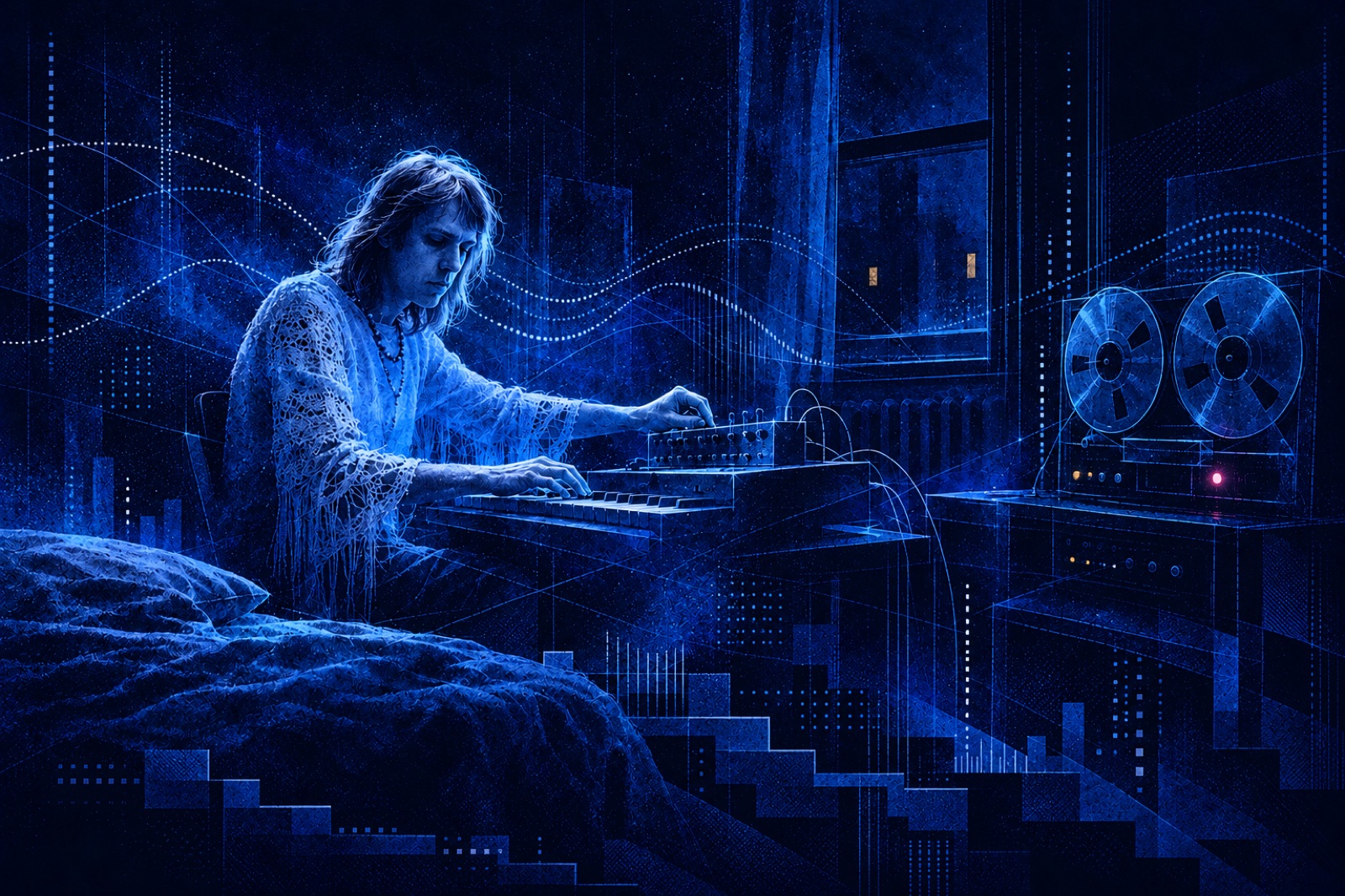
He recorded the album in Berlin between March and June 1975. The sleeve credits the “Berliner Weltklang Studio”. It was his bedroom, in the apartment in Schwäbische Straße; Weltklang was the name of a label he planned so that he could release pieces longer than an LP side allowed. For the second side he got hold of a cheap eight-track tape machine, his first after four albums on a two-track Revox.
The first side came in a single night in early June. He played “Bayreuth Return” live, in one go, onto two tracks, between ten o’clock and midnight. “When you are in a good mood you can make it in two hours, and if you are in a bad mood, you throw away 100 hours,” he told an interviewer. He didn’t want to compose intellectually: the music had to flow out of him and onto the tape. Looking back in 1993, he was struck by how little it had taken. “Timewind was so surprising because for me it was such simple stuff. It was a real live recording.”
“Bayreuth Return” opens on a sharp, whistling wind and twittering electronic sounds, with warm synthesizer pads beginning to drift above them. Then a bass line comes in and lifts the pace, and from there the piece rests on what The Guardian called “a shimmering sequencer passage that Schulze endlessly manipulates so that the track’s rhythm subtly shifts”. It gathers energy as it goes, the sequence speeds up near the end, and the side closes on a crash. The Guardian heard in it “the sound of Schulze reaching the pinnacle of his 70s style”.
Press ▶ in the player to start.
This video can’t be played here. It may be blocked where you are, or no longer available. Try it on YouTube ↗
Listen
Klaus Schulze, “Bayreuth Return” (1975), from the entry of the bass line
Listen for: the sequencer passage whose rhythm subtly shifts as Schulze manipulates it.
Full piece on YouTube ↗Playing loads this video from YouTube (Google); Google’s privacy policy applies.
The other side is slower and darker. “Wahnfried 1883” has no driving sequence at all. It is built from richly textured chords over a droning organ, and over its last ten minutes the front line of sound breaks into fragments that oscillate and echo, until, in the words of Greg Allen, one of Schulze’s biographers, “a general feeling of raw intensity develops”. The French magazine Rock & Folk called it “a pure masterpiece”, the most accomplished thing Schulze had made, and Schulze kept a soft spot for it as “real floating music”.
Press ▶ in the player to start.
This video can’t be played here. It may be blocked where you are, or no longer available. Try it on YouTube ↗
Listen
Klaus Schulze, “Wahnfried 1883” (1975), the last ten minutes
Listen for: the front line of sound breaking into fragments that oscillate and echo.
Full piece on YouTube ↗Playing loads this video from YouTube (Google); Google’s privacy policy applies.
The titles are a dedication. Bayreuth is the Bavarian town where Richard Wagner founded his festival, and Wahnfried is the house he lived in there; Wagner died in Venice in 1883 and was buried at Wahnfried. Asked what drew him to Wagner, Schulze named “his newly found chords” and “his stamina (staying power)”. He didn’t make a creed of it. “I dig Wagner. But I also dig J.J. Cale.” The connection lasted all the same: from 1979 he released records under the name Richard Wahnfried, after his son Richard and Wagner’s house.
The Swiss painter Urs Amann, whose surreal, Dalí-like work Schulze had already used on Blackdance, came to Berlin to hear the music and painted the cover and an inside picture for it. The back of the gatefold carries a “score” of “Wahnfried” in Schulze’s hand: symbols, sketches and notes showing which synthesizer played on which of the eight tracks, with instructions for “white noise” and “pink noise” in place of notes. It was drawn after the music was finished.
Timewind came out in August 1975, and that autumn Schulze left Berlin for a house in the forest at Hambühren, near Hanover. British reviewers were mostly won over; one suggested it might “become recognized as the classic of the seventies”. In France Rock & Folk called it “an hour of splendid music”, an album “to listen to very loud”. By December it was in the French and Dutch charts, and then the Académie Charles Cros in Paris gave it the Grand Prix International du Disque. Magazines reported that it won as a classical recording; Schulze himself said the prize went to non-classical musicians, in a category called musique tendance actualité. He collected the prize at the Paris congress center alongside Pierre Boulez. The prize had a practical side. Every French university and public library had to take two or three copies of each prizewinner, and 20,000 to 30,000 orders came in practically overnight. With the money, Schulze rented a professional studio for his next album.
Moondawn
He also left Virgin. He and his manager Klaus D. Müller had the impression that the label promoted Tangerine Dream first and had signed Schulze mainly to keep a rival under control. He ended the contract early in 1976, and fifteen years later a Virgin executive confirmed their suspicion. Outside Germany the next record went to a new French label, Isadora.
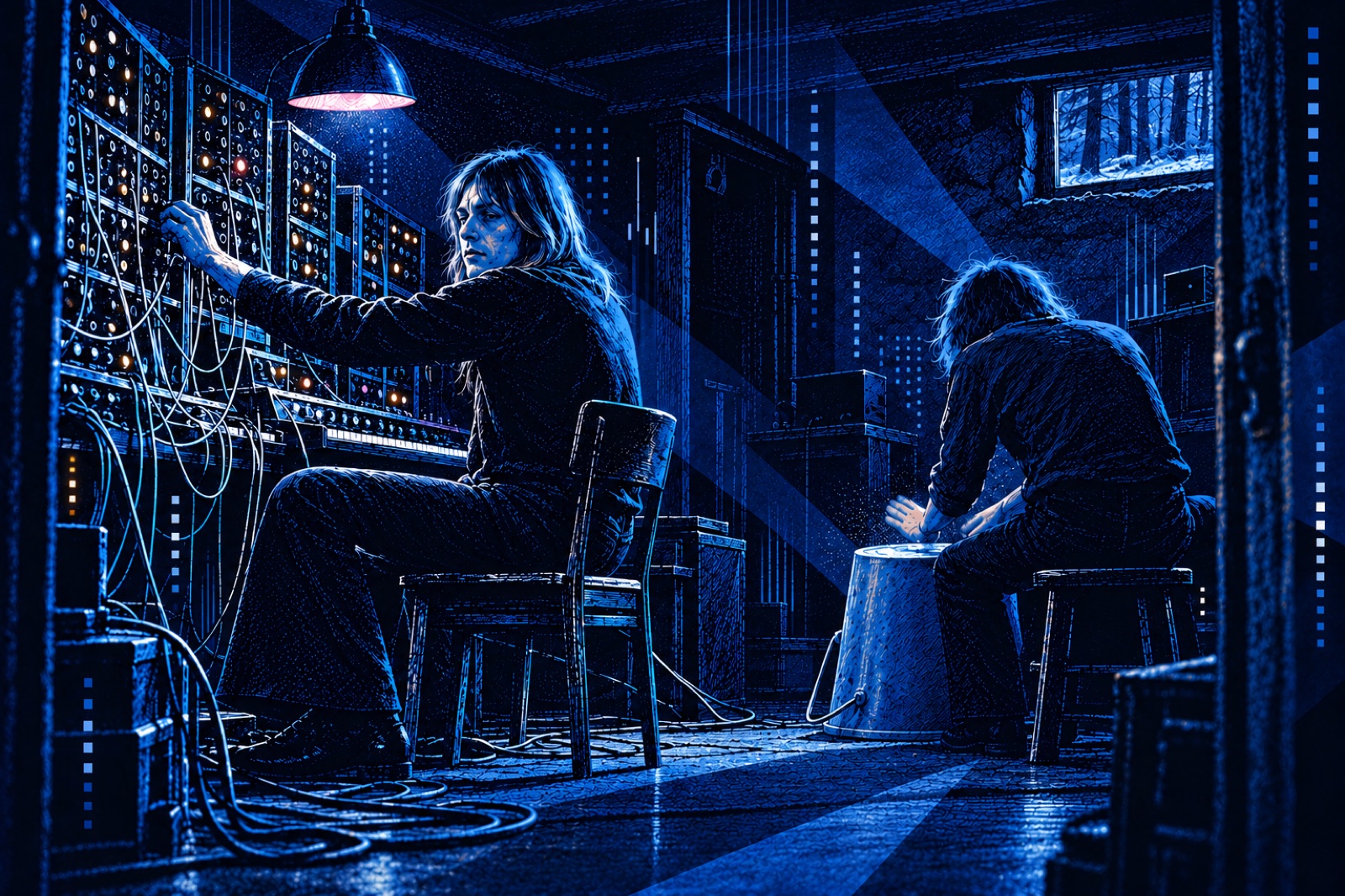
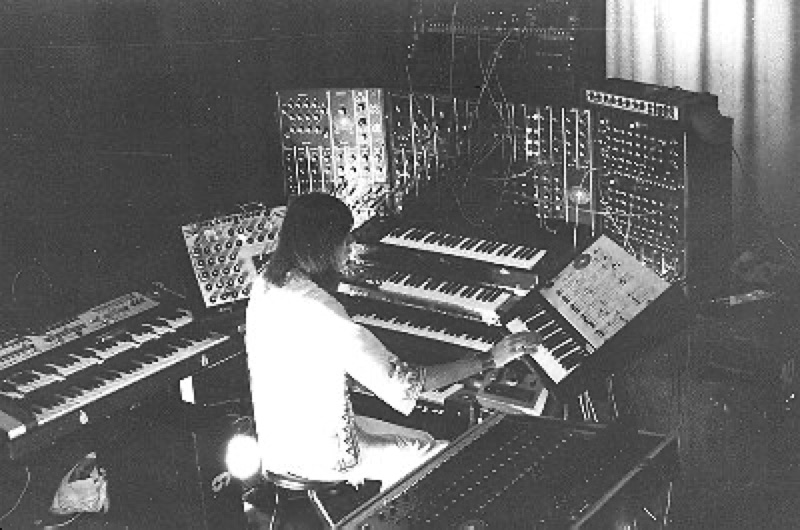
The machine came first. Schulze heard that Florian Fricke of Popol Vuh wanted to sell his big Moog modular system for 20,000 marks, which he didn’t have. He drove to his record company in Hamburg and threatened to make no more albums unless it advanced him the money, and the company wrote him a check. From Hamburg he drove on to Munich, handed Fricke the check and loaded the boxes into his car, only to find that the most important part was missing. The sequencer, which Fricke had never used, turned up gathering dust in his basement. Back home in December 1975, after twenty hours on the road, Schulze set the Moog up and got the first powerful sounds out of it that night. It was the same instrument Fricke had brought to Tangerine Dream’s sessions for Zeit in 1972. Set up as a straight wall behind Schulze on stage, it became his emblem for the rest of the decade.
Then came the drummer. Harald Grosskopf, who had played in the band Wallenstein, had met Schulze at the Cosmic Jokers sessions. He had found Irrlicht “unbearable”, too intellectual, but Blackdance, heard on the radio as he lay in bed, thrilled him. “It grooved. My band Wallenstein didn’t.” He wrote to Schulze and was invited to the new house, and Schulze took him down to the cellar studio, where the big Moog stood, and switched on the sequencer, a word Grosskopf had never heard. “I was thrilled by the groove that ‘dead’ machine produced,” he remembered. There was no drum kit in sight, so he grabbed a plastic bucket and drummed along. Schulze, sitting with his back to him, turned around and smiled, and when the session ended he said: “We must do the next album together!” Months later a telegram told Grosskopf to be at a studio in Frankfurt on a given date.
Schulze explained the decision that summer. A sequencer could be sped up or slowed down, but its rhythm “always remains a little mechanical”; a good drummer could make rhythm come alive. And there was a second reason. Alone on stage he could only hold a conversation with his synthesizer, “always asking and answering at the same time”. With Grosskopf, “a musical conversation takes place”.
The studio, Panne-Paulsen, was small, in a former cinema, run by an electronics engineer who built most of the equipment himself. “What a tiny little studio thing!” Grosskopf thought. Neither man could read or write music then, and Grosskopf, used to rehearsing for a month before recording, found that Schulze worked entirely by feeling and improvisation. “Klaus gave no advice at all. Never ever!” Nothing happened until late in the afternoon. The Moog took ages to tune, and opening a door for five minutes was enough to send its oscillators drifting.
The first take of what became “Floating” stopped after five minutes, because Grosskopf didn’t feel it. They talked for a moment, and Schulze said: “I see you know where we are going, let’s do it again!” The second take is the A-side, twenty-five minutes without, in Grosskopf’s words, any “emotional break or technical mistakes”. When the last note faded they met in the control room and hugged. “Moondawn was a perfect sketch, a classic first take,” Grosskopf said. He found the sequencer freed him: with the machine holding the rhythm, the drummer no longer had to mark the beat and could play with texture instead.
“Floating” begins with a voice reciting the Lord’s Prayer in Arabic, which Schulze had on tape and used only for its sound. Then the music rises out of near-silence on orchestral synthesizers, and only after several minutes the drums and the Moog’s sequence fade in and take over, settling into a groove on the ride cymbal. There is a sequence in each channel, slightly out of step with the other. A German reviewer in 1976 called it “unbelievably relaxed, outwardly almost monotonous, but inwardly an extremely differentiated music”. The Guardian called it “deep and exceptionally beautiful”.
Press ▶ in the player to start.
This video can’t be played here. It may be blocked where you are, or no longer available. Try it on YouTube ↗
Listen
Klaus Schulze, “Floating” (1976), from the entry of the drums
Listen for: the drums and the Moog sequence fading in, and a sequence in each channel, slightly out of step with the other.
Full piece on YouTube ↗Playing loads this video from YouTube (Google); Google’s privacy policy applies.
“Mindphaser” is the rock side. It builds from searching synthesizer lines and organ until, just before the twelfth minute, the drums break in, and from there it never slows, with Schulze soloing freely over the backing. The Guardian found the change “genuinely stunning”, drumming that “doesn’t so much power the music as dance around the synthesisers”, and called the piece “a masterpiece of what became known ... as the Berlin School”. The sleeve said it had opened a door he had wanted to go through for years, rock music, and that now he could go on to open another. To Rock & Folk, though, he said rock was dying and that with Moondawn he was bidding it “a definitive and vehement farewell”.
Press ▶ in the player to start.
This video can’t be played here. It may be blocked where you are, or no longer available. Try it on YouTube ↗
Listen
Klaus Schulze, “Mindphaser” (1976), from just before the twelfth minute
Listen for: the moment the drums break in, and how they move around the synthesizers instead of driving them.
Full piece on YouTube ↗Playing loads this video from YouTube (Google); Google’s privacy policy applies.
The back of the sleeve listed his instruments in detail, and a young Californian, Steve Roach, bought his first synthesizers by studying it.
Moondawn came out on 16 April 1976. The tour had already begun, at the Salle Pleyel in Paris on 3 April, in a series called “A Farewell to Pop-music”. The record became the best-selling one Schulze had made so far, and in France a hit, reaching No. 10 in the album chart. At home the response was mixed. Grosskopf remembered “a lot of skepticism, mostly bad press” in Germany and “overwhelming reactions” in France and England.
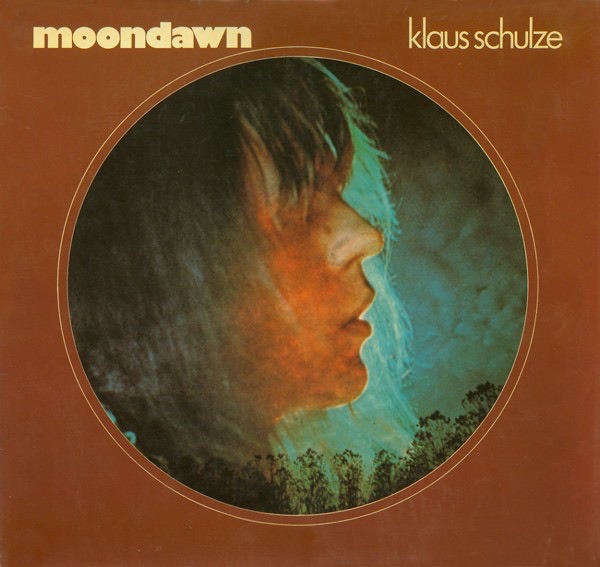
Its reputation has grown since. For many serious listeners, the AllMusic critic Jim Brenholts wrote, it was “the first and/or most important electronic music purchase”, and Schulze’s own discography calls it “the first masterpiece in the typical Schulze style”. The writer David Stubbs dates the moment the Berlin School style “would become codified” to this record. Schulze’s fans have twice voted “Floating” the best piece he ever recorded, and Schulze himself, asked in 2011 which of his albums he was most proud of, named Moondawn first.
What they left
The two records found their listeners early, and some of those listeners became musicians. Steve Roach found Timewind in early 1978, unpacking a box of imports at the record shop in La Mesa, California, where he worked. “At first play I was taken over; things were different, changed forever after that one,” he said. In England Ian Boddy heard Timewind on the radio at one in the morning and phoned the station to ask what it was. In Germany Detlef Keller decided to make electronic music after hearing both records. Bernd Kistenmacher heard Moondawn at sixteen and calls it “the most influential recording” of his life, “Floating” above all. And in Philadelphia, when John Diliberto played Moondawn on the radio, he had “never seen the phone lines light up the way they did that night”.
For Grosskopf, Moondawn was a turning point. Afterward rock music bored him; he left Wallenstein, moved to Berlin and joined Manuel Göttsching’s Ashra. A French magazine nicknamed him “Monsieur Séquenceur”, and he later used the name for his autobiography. Asked for his favorite recording of his whole career, he answered: “Definitely Moondawn.”
Schulze was more detached. In 1993 he put both records among those “of their time”, which technology had overtaken, though he still loved them. He kept playing the big Moog for years, and the year after Moondawn he made Mirage, his electronic winter landscape. When Island signed him for it, the label was hoping for “a second Moondawn”.
Back to the main storySection 4, “The pulse”, after Moondawn ←