
Companion story
Phaedra
At the end of 1973 Tangerine Dream had made four albums for a German label they had just walked away from. In Britain they had begun to be noticed. John Peel had made Atem his album of the year on the BBC, and he had written to Edgar Froese and phoned him to say how much he loved it. Imported copies of the band’s records were selling. Virgin, a young London label that had started as a mail-order shop, had noticed.
The band was down to two that summer. Peter Baumann had gone traveling in Nepal and India, and Froese and Christopher Franke carried on as a duo, recording an album with what little equipment they had. When Baumann came back, the three of them played Virgin their tapes, and Richard Branson offered them a contract and a place to record: The Manor, the label’s residential studio in a manor house at Shipton-on-Cherwell in Oxfordshire, where Mike Oldfield had made Tubular Bells. Virgin didn’t want the duo album; it asked for a new one. Green Desert stayed on the shelf until 1986.
The advance paid for the instrument that made the difference. It was a big modular Moog synthesizer that had belonged to the Rolling Stones and had ended up at Hansa Studios in Berlin, where nobody knew how to use it. Franke had been practicing on it night after night, and what he had found in it was its sequencer, the part that could play a short row of notes by itself, over and over. “It really set the flavour for the main piece,” Baumann said later.
The sessions
The sessions began at The Manor in November 1973, with Phil Becque as engineer and, in the words of one account, “almost unlimited funds”. They fell during the British miners’ strike. The first two days went on repairs; a crackle in the mixing desk turned out to be a loose contact in one of its modules. Then the rain came in through the old roof, and two hours later, in Froese’s telling, the studio “looked like a Christo-wrapped instrument park”, the instruments wrapped in plastic sheeting. Until this record, Froese said, Tangerine Dream had only improvised. Now, with the Moog’s sequencer playing the bass for the first time, much of the music had to be structured.
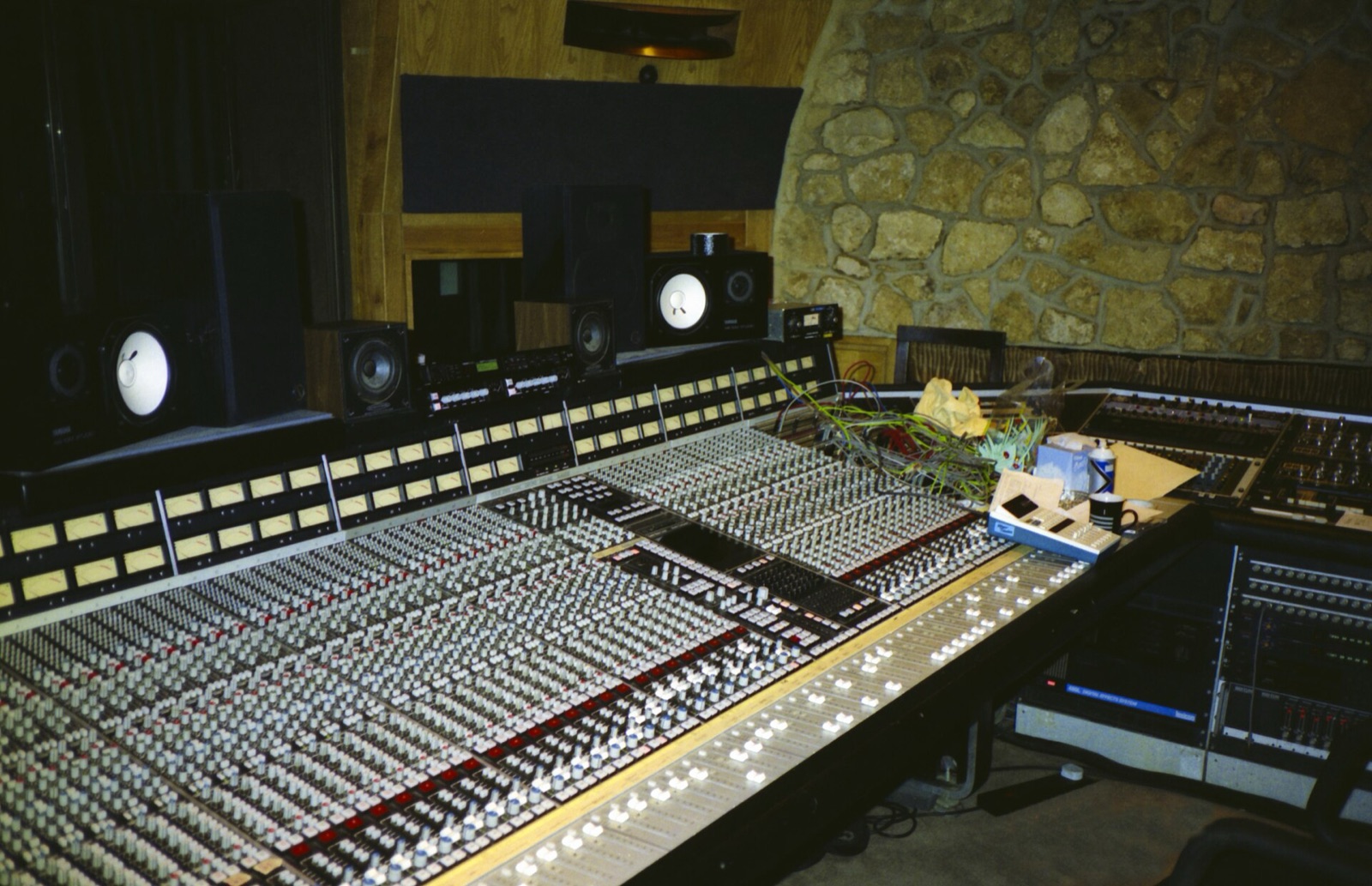
What followed was the record’s opening: eleven days of failures, barely six minutes of music, two days off in the countryside, and then a bass pattern that slipped out of tune while Franke, not knowing the tape was rolling, retuned it as it ran. Even Froese’s first melody over the pattern, he said, “was just a try – no one thought it would go on the record”. Baumann remembered it more simply: “Christoph was unaware that we were already recording it.”
They kept the take. “We recorded quite a bit, and a lot of it was junk that we threw out,” Baumann said, but this one they refined, layering Mellotron, guitar, bass, electric piano and flute over the sequencer’s line, and adding the heavily delayed, processed sound that now opens the piece. As the Moog warmed up, its oscillators drifted out of tune. The changes in pitch and tempo that came with that were unintended but kept, and they give the piece much of its sense of drift. The next day Virgin’s Simon Draper called in at the studio and was stunned by what he heard.
Press ▶ in the player to start.
This video can’t be played here. It may be blocked where you are, or no longer available. Try it on YouTube ↗
Listen
Tangerine Dream, “Phaedra” (1974), from the start
Listen for: the processed haze of the opening, then the Moog bass line fading in, and the note that slips out of tune a few seconds after it starts.
Full piece on YouTube ↗Playing loads this video from YouTube (Google); Google’s privacy policy applies.
The title track
“Phaedra” fills the whole of the first side, seventeen and a half minutes. It begins in a haze of delayed and treated sound that recalls the band’s earlier records, music without a pulse. Then a circling bass line on the Moog fades in, and ghostly Mellotron melodies drift above it. Later a small synthesizer, an EMS VCS 3, takes up a two-note melody, and the weight of the piece shifts to rhythm.
Midway through, Franke makes the Moog’s notorious drift into an effect: the pitch of the pattern rises and rises until the figure falls apart. What follows is a passage of synthetic birdsong and Mellotron chords, and the piece ends a long way from where the sequencer started it.
A musicologist, Alexander Harden, has heard the piece in three parts: a synthetic landscape of sequenced lines in reverb and delay that settles into a bass line and a Mellotron choir; a middle in which picked bass, flute trills, electric guitar and Mellotron clusters thicken around the panning sequence; and a close in which the sequencer recedes into metallic sounds, a drone and birdlike calls before Mellotron strings carry it home. For Harden the whole thing is a model of how this music was made: a large space that is plainly built in the studio, sounds with no recognizable acoustic source, and players heard in the shaping of sound more than in the playing of notes. The same three-part shape turned up a few years later in Spain, in the first album of the Barcelona group Neuronium.
Press ▶ in the player to start.
This video can’t be played here. It may be blocked where you are, or no longer available. Try it on YouTube ↗
Listen
Tangerine Dream, “Phaedra” (1974), the middle section
Listen for: the pitch of the sequence rising until the pattern breaks up, then the birdsong.
Full piece on YouTube ↗Playing loads this video from YouTube (Google); Google’s privacy policy applies.
The other side
The second side has three shorter pieces, each made in a different way.
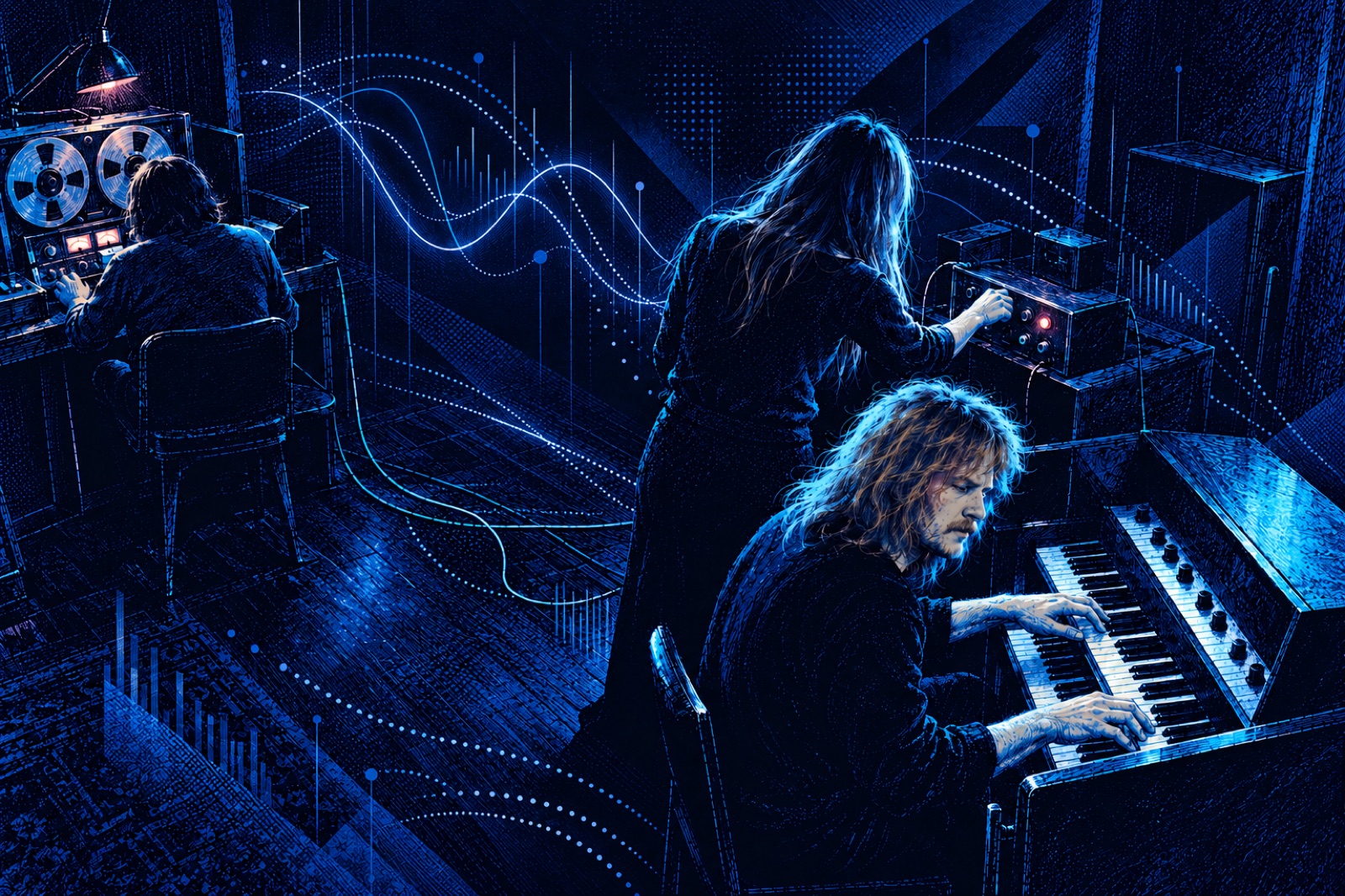
“Mysterious Semblance at the Strand of Nightmares” was recorded in December. Baumann and Franke were asleep after a long session, so Froese called in the engineer and his wife, Monique. He played the piece in a single take on a double-keyboard Mellotron while she set the speed of a phasing device by hand, turning its knobs as he played. Her part, he wrote, “was not to be underestimated”. What is on the album is that take, exactly as it was played. The writer Mark Prendergast heard in it “a sub-aquatic feel, all thick Mellotron and effects”.
Press ▶ in the player to start.
This video can’t be played here. It may be blocked where you are, or no longer available. Try it on YouTube ↗
Listen
Tangerine Dream, “Mysterious Semblance at the Strand of Nightmares” (1974)
Listen for: one take on the Mellotron, with Monique Froese turning the phaser by hand.
Full piece on YouTube ↗Playing loads this video from YouTube (Google); Google’s privacy policy applies.
“Movements of a Visionary” was recorded one evening after a run of unproductive discussions, and it brought the album up to its minimum playing time. It brings back the sequenced Moog under organ and electric piano, with guitar set against the sequencer and treated voices and whispers pushing its arpeggios along.
The last piece came out of a small rivalry. Baumann had been unhappy that Froese had a solo piece on the album and he did not, so he stayed up all night and played the others a piece of his own: “Sequent C’”, two minutes of a wooden recorder, overdubbed several times and fed through tape echo and delays. It is often mistaken for a flute. Froese came round to its atmosphere, and it closes the record.
What they meant by it
The band saw Phaedra as a step back toward its listeners. “For two or three records we did not add too much rhythm,” Froese said in 1982. The idea now was to use the sequencer more, “so that people could feel the ground they’re familiar with”, and to put all the strange sounds on top. Nothing on the market had been built that way, he said: there was Walter Carlos’s Switched-On Bach, a little Tomita, the first beginnings of Keith Emerson, “but none of that was based on what we started to do, doing the pure sequencer work.”
Their method was still improvisation. In the studio, Froese and Baumann explained in the summer of 1974, they simply started to play, then picked out the best moments and improvised again on the same material, because a record is heard far more often than a concert. When an interviewer asked about critics who found the music short of guts and aggression, Froese replied: “Why must music be aggressive? You have only to walk outside your house and there is so much aggression around... why must we have all that in our music?”
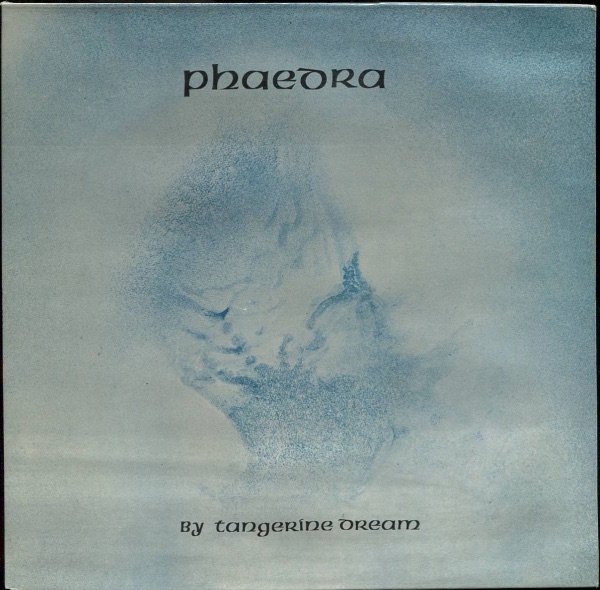
The title came from Greek myth. Phaedra, the daughter of Minos and wife of Theseus, took her own life after her stepson Hippolytus rejected her love. Froese painted the blue and gray abstract image on the cover himself, and the gatefold carried ten more of what one writer called his “psychedelic, light show blob paintings”. The band thought of its sleeves as part of the music. Mojo later decided that Phaedra had become “the only album cover on which any self-respecting head would be seen rolling a joint”.
Release
Phaedra came out in Britain and West Germany on 20 February 1974. The band gave few interviews to the music press, and apart from John Peel’s shows almost no one played it on the radio. It went into the British album chart in April anyway, climbed to No. 15 and stayed for fifteen weeks, and over the years it sold around a hundred thousand copies there. Baumann was on holiday in Italy when a telegram from Branson told him to come to London for interviews, because the record was in the top ten. “I just looked stunned and said, what top ten?” he remembered. He said years later that he still couldn’t explain its success.
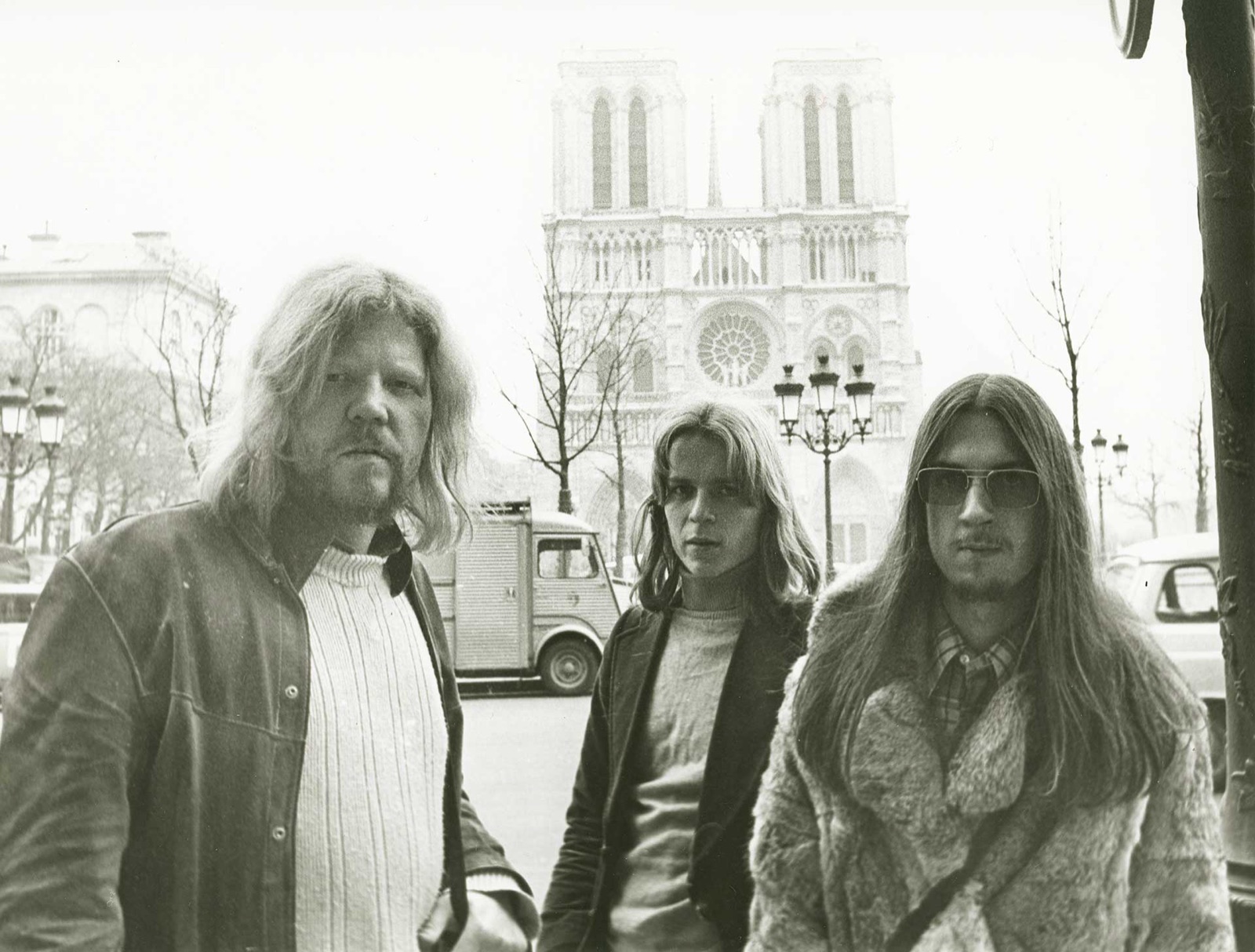
In America imported copies were already selling in the spring, and by early June Billboard was calling it England’s best-selling import there. FM stations from Baltimore to San Francisco added it to their playlists, and it became the first of seven Tangerine Dream albums to reach the American charts over the next twelve years. It went gold in several countries. In West Germany, where the band had been working for years, it sold barely six thousand copies.
The British critics were divided. In Melody Maker, Steve Lake called it “gutless and spineless, devoid of inspiration”. Froese said that reading a Melody Maker review felt “like eating marshmallows topped with vinegar”. Rolling Stone’s reviewer was won over by “three visionary German kids” and called it “an immensely enjoyable experience”. And John Peel, introducing the band at London’s Rainbow Theatre that year, told the audience: “When Phaedra went into the LP charts, it was one of the great moments of my life.”
On stage
Phaedra changed the concerts too. Only a few years earlier, audiences had thrown fruit and vegetables at the band; at London’s Rainbow in 1974, Resident Advisor wrote later, the crowd was “full of excited fans who were converted” by Phaedra. The band played in near darkness, sitting at their machines. Interest in the album reached the theater too. The actor Keith Michell, fascinated by what he called its “space time element”, hired the band to write music for his production of Oedipus Tyrannus at the Chichester Festival Theatre that year.
Afterward
The record changed the band’s life, and Virgin’s. “It helped build a career I never dreamed of,” Froese said. Most of the money went straight into new equipment, and when the band went back to The Manor a year later to make Rubycon, they were, in Froese’s words, “weighed down by the success of Phaedra”, with a pressure to “do it again”. With the albums that followed, Tangerine Dream became Virgin’s second best-selling act of the decade, behind Mike Oldfield and ahead of the Sex Pistols. The Quietus has pointed out that Phaedra came out about eight months before Kraftwerk’s Autobahn, the record that usually gets the credit for electronic music’s synthetic turn.
Many who heard it have said what it did to them. Mark Shreeve of Redshift heard it on John Peel’s show after a night at the pub. “Almost instantly I thought, this is possibly the most beautiful thing I’ve ever heard in my life,” he said. Robert Rich found a “liquid fluidity” in it, Moby heard “machines singing to us”, and William Friedkin loved it so much that he wanted “more of the same” for his film Sorcerer, which became the band’s first Hollywood score. For the radio host John Diliberto, who first heard Tangerine Dream on it in 1974, the album was “the Sgt. Pepper’s Lonely Hearts Club Band of space music. Nothing was the same after it came out.”
Not everyone has been converted. Julian Cope, who championed the band’s first four albums, wrote that after them “they sank into the easy-listening sound of Phaedra”. A reviewer in 2018 found it “both boring and unnerving”. For most of the band’s admirers, though, the classic period starts here.
The album kept coming back. In 2018 the title track and “Mysterious Semblance” turned up in the interactive film Black Mirror: Bandersnatch, and the following week Phaedra was the best-selling ambient album on Amazon. In 2019 it opened the band’s box set of its Virgin recordings, newly remixed by Steven Wilson, and for its fiftieth anniversary a five-disc edition added about a hundred minutes of outtakes from the 1973 sessions and the band’s first British concert. The band, now led by Thorsten Quaeschning, toured a “Phaedra experience” in 2025, and its concert at the Barbican came out in January 2026, opening with new versions of all four pieces.
Back to the main storySection 1, “A rehearsal”, at the end of the section ←